

Why Vinyl Graphics Can Shrink
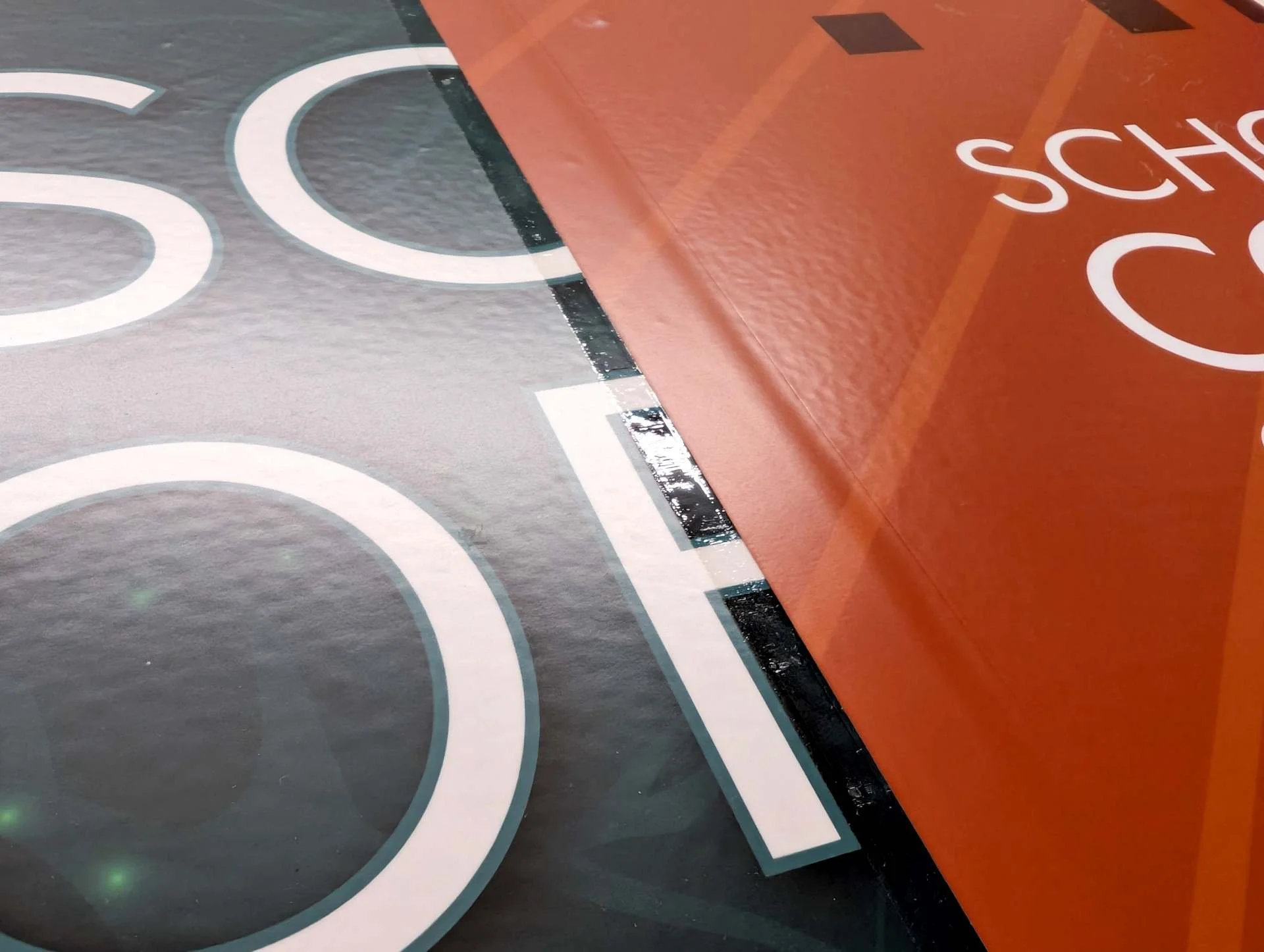
Extreme vinyl shrinkage that leaves traces of glue, can occur where materials have not been allowed to outgas sufficiently before finishing or where lower-quality, less dimensionally stable media has been used. Image shown is a test sample created for illustration only and does not represent a live project.
Vinyl graphics are dimensionally stable materials, but they are not dimensionally immovable. Small amounts of shrinkage can occur during the service life of self-adhesive vinyl, and temperature is one of several factors that influence how visible that movement becomes.
This is particularly relevant to wall graphics, manifestations, window graphics and other large-format installations where even a small change can become noticeable along a join or perimeter. A graphic covering several metres of wall can make movement much easier to see than the same behaviour on a small decal.
Shrinkage does not automatically mean that a material is defective or that an installation has failed. Manufacturers publish dimensional-stability values for their films precisely because some movement is an expected physical characteristic. The important questions are how much movement has occurred, what material was specified, how it was installed and what environmental conditions it has experienced.
Key Takeaways
Vinyl is dimensionally stable, not dimensionally fixed. Heat can allow internal stresses within the film to relax, while repeated heating and cooling cycles can make dimensional movement more visible.
Polymeric vinyl generally provides better dimensional stability than short-term monomeric films, while cast vinyl offers greater stability for demanding applications. Neither should be assumed to have zero shrinkage.
Environmental conditions significantly affect performance. A polymeric wall graphic in a climate-controlled office may experience minimal movement, while the same type of film in a hot, unconditioned reception can experience substantially greater thermal cycling.
The substrate matters. Painted walls, metal, plastic and glass absorb, transfer and respond to heat differently, so identical vinyl can behave differently depending on the surface beneath it.
Significant shrinkage should be assessed as a complete system, considering the film specification, installation tension, adhesive performance, substrate, temperature exposure and manufacturer tolerances rather than assuming a single cause.
Vinyl Is a Flexible Plastic Material
Most conventional self-adhesive signage films are PVC-based materials. Like other plastics, their physical behaviour changes with temperature.
When the material becomes warmer it can expand and soften. As temperatures reduce, it contracts again. Repeated heating and cooling therefore subject an installed graphic to continuous dimensional changes, even though those changes may be extremely small under normal conditions.
There is another factor: internal stress within the film.
Manufacturing and installation can introduce tension into vinyl. When heat allows that tension to relax, the material naturally attempts to return towards a less stressed state. This is commonly described as the film's "memory".
Manufacturer guidance acknowledges this behaviour. Avery Dennison, for example, states that calendered films exhibit memory for their original shape and that heating and stretching can induce shrinkage. (Avery Dennison Graphics)
This is one reason correct material selection and installation technique matter.
Polymeric Vinyl Can Still Shrink
There is sometimes a misconception that specifying polymeric vinyl means shrinkage cannot occur.
Polymeric calendered films generally provide better dimensional stability than short-term monomeric films and are widely used for medium and longer-term flat applications. Dedicated polymeric wall films are specifically manufactured with dimensional stability in mind. (Avery Dennison Graphics)
But improved dimensional stability does not mean zero movement.
Technical data for individual polymeric films can specify measurable maximum shrinkage under test conditions. One ORAFOL high-performance polymeric film, for example, publishes maximum longitudinal shrinkage of 0.4mm when bonded to steel under its specified test method. (ORAFOL)
The exact figure varies by product and testing method, so there is no sensible universal shrinkage allowance that can be applied to every polymeric vinyl.
Instead, the material should be understood as dimensionally stable within defined tolerances, rather than dimensionally fixed.
Cast Vinyl Provides Greater Dimensional Stability
Cast vinyl is manufactured differently from calendered film and generally carries less internal stress. It is consequently preferred for demanding applications requiring greater conformability and dimensional stability.
The difference can be seen in manufacturer data. ORAFOL publishes maximum longitudinal shrinkage of 0.1mm for one of its premium cast films under its specified test conditions, compared with 0.4mm for the polymeric calendered example above. (ORAFOL)
Avery Dennison similarly describes premium cast products as offering excellent dimensional stability and recommends cast materials where conformability is required. (Avery Dennison Graphics)
That does not mean cast film can never move. Manufacturer installation guidance notes that even cast materials can develop problems where they are excessively stretched or heated. (Avery Dennison)
Material selection reduces risk. It does not repeal physics.
Scenario One: Polymeric Wall Vinyl in an Air-Conditioned Office
Consider a large polymeric wall graphic installed in a modern air-conditioned office.
The building maintains a relatively stable internal temperature throughout the working day and year. The wall itself is protected from direct solar heating, humidity is reasonably controlled and the graphic has been correctly installed onto a suitable, stable painted surface.
This is a favourable environment for polymeric vinyl.
The film will still respond to changes in temperature, and a small amount of dimensional movement can occur over its service life. However, because the environmental changes are relatively modest, the repeated expansion and contraction experienced by the material are limited.
Any shrinkage is therefore likely to be minimal and may never become visually significant.
On a multi-drop wall graphic, very small changes may eventually become detectable at a join or perimeter because these locations provide an obvious visual reference. That does not necessarily indicate abnormal performance.
This is an important distinction when assessing large-format graphics. Minimal shrinkage and zero shrinkage are not the same specification.
Scenario Two: Polymeric Vinyl in an Unconditioned Reception During a Heatwave
Now place a similar polymeric wall graphic in a reception or lobby without air conditioning.
During a summer heatwave, external temperatures reach approximately 30°C. Large areas of glazing introduce solar gain and the reception becomes considerably warmer during the afternoon.
The temperature falls again overnight.
The following day, the process repeats.
The vinyl, adhesive, wall and surrounding materials are therefore experiencing a substantially greater thermal cycle than those in the air-conditioned office. As the graphic heats, the material responds to the increased temperature. As the building cools, it contracts again.
Repeated cycles can make dimensional movement more apparent, particularly at joins and edges.
The surface temperature also matters more than the weather forecast. A graphic or sign exposed to direct sunlight can reach a substantially different temperature from the surrounding air, particularly where the substrate or adjacent finishes absorb solar energy.
This is why two identical graphics installed in the same building can behave differently if one occupies a stable internal corridor and another sits beside a large south-facing glazed reception.
Why Installation Tension Matters
Temperature is only part of the equation.
Vinyl that has been stretched during installation contains additional tension. When subsequent heat allows the material to relax, it may attempt to recover towards its original dimensions.
This behaviour is particularly relevant around curves, recesses and complex forms, although unnecessary stretching should also be avoided on straightforward flat applications.
Manufacturer technical guidance for cast films specifically addresses areas exposed to stretch or deformation and requires appropriate post-heating procedures for applicable installations to relieve tension. (Avery Dennison)
For flat wall graphics, good installation practice is generally to position and apply the material without unnecessarily stretching it into place.
A graphic should fit because the artwork, panels and installation have been prepared correctly, not because the material has been pulled until it reaches the required position.
Adhesive and Substrate Also Influence the Result
Visible movement should not automatically be attributed to the face film.
A self-adhesive graphic is a system consisting of the film, adhesive and substrate. Paint condition, surface preparation, moisture and substrate stability can all affect what happens after installation.
If adhesion at an edge is compromised, normal dimensional movement within the vinyl becomes easier to see because the material is no longer being retained as intended.
Wall graphics therefore require appropriate surface preparation and adhesion testing where suitability is uncertain. Avery Dennison's guidance for interior wall graphics specifically recommends test application to confirm satisfactory adhesion to the chosen surface. (Avery Dennison Graphics)
Different Surfaces Respond Differently to Temperature
The substrate beneath a graphic also changes how the complete installation responds to heat. Vinyl applied to a painted wall, metal panel, plastic surface or glass is not operating under identical conditions because each material absorbs, transfers and responds to temperature differently.
Painted internal walls are generally comparatively stable when the building temperature is controlled, although the performance of the graphic still depends on the paint system, curing and adhesion of the coating to the wall beneath it. In an unconditioned space, the wall itself will warm and cool with the building, creating greater temperature variation across the installation.
Metal can respond much more noticeably to changing temperatures. Aluminium and other metals conduct heat efficiently and can become considerably warmer when exposed to direct sunlight. The substrate also expands and contracts as its temperature changes, meaning the applied vinyl is effectively responding both to its own dimensional movement and to movement of the surface beneath it.
Plastic substrates introduce another variable because different plastics have different rates of thermal expansion. Some plastic panels can move considerably as temperatures change, particularly across larger dimensions. Dark-coloured plastics can also absorb substantial solar energy, increasing surface temperature. Compatibility must additionally be considered because certain plastics can interact with pressure-sensitive adhesives or release substances that affect adhesion.
Glass is dimensionally stable in comparison with many plastics, but glazing exposed to direct sunlight can still become very warm. Window graphics may therefore experience substantial temperature changes between direct daytime solar exposure and cooler night-time conditions. The effect can be particularly pronounced on south-facing glazing or within reception areas containing large expanses of glass.
The substrate should therefore be considered as part of the complete graphic system. The same vinyl applied to four different surfaces can experience four different combinations of temperature, expansion, adhesion and environmental exposure. This is why material selection should consider not only whether an installation is internal or external, but exactly what the graphic is being applied to and the conditions that surface will experience.
Heat Does Not Affect Every Installation Equally
The phrase "30°C heatwave" can be misleading when discussing graphics.
What matters to the material is its own temperature and the conditions immediately around it, not simply the official outdoor air temperature.
An internal graphic in an air-conditioned office might remain close to a controlled room temperature throughout the same heatwave. A reception graphic behind extensive glazing could experience much higher temperatures during the afternoon before cooling substantially overnight.
External installations experience an even wider range of conditions.
Orientation, glazing, ventilation, substrate colour, direct sunlight and surrounding architecture all influence thermal exposure. The same specified vinyl can therefore perform differently across different locations without either installation necessarily being incorrectly specified.
Small Gaps at Joins Can Become More Visible
Shrinkage is particularly noticeable on wall graphics produced in multiple drops.
Each individual panel may move by only a small amount, but a join creates a defined reference line. If neighbouring panels move away from that line, the underlying wall can become visible.
This is one reason production and installation methods need to account for the characteristics of the material being used. Panel construction, overlaps where appropriate, trimming methods and the manufacturer's application guidance all influence long-term appearance.
Large expanses of solid colour can make changes particularly noticeable because there is nothing visually interrupting the join.
The presence of a fine line after prolonged exposure does not, by itself, establish why the movement occurred. The amount of shrinkage needs to be considered against the particular product's specification and installation conditions.
Choosing Materials According to the Environment
Material specification should reflect where the graphic will actually be installed.
Polymeric films can be an excellent choice for appropriately prepared flat walls and many medium to long-term signage applications. Manufacturers produce polymeric wall films specifically for applications where dimensional stability is important. (Avery Dennison Graphics)
Cast films provide greater conformability and dimensional stability where the application demands it, but their additional performance is not automatically necessary for every flat internal wall.
The appropriate question is therefore not simply, "Which vinyl is best?"
It is:
What level of dimensional stability, conformability and durability does this particular installation require?
A climate-controlled office, sun-exposed reception, external sign and complex architectural wrap present different conditions and should not automatically receive the same specification.
When Shrinkage Should Be Investigated
Some dimensional movement is inherent to self-adhesive films, but substantial or rapid changes warrant investigation.
Large gaps between panels, widespread edge lifting, significant curling or movement occurring unusually soon after installation may indicate that something beyond normal dimensional behaviour is happening.
The assessment should consider the film specification, manufacturer's published tolerances, installation method, substrate, adhesive performance and environmental exposure rather than assuming a single cause.
Where possible, retain the product specification and installation information for larger graphics projects. That provides a useful reference if the installation needs to be assessed later.
Understanding the Difference Between Movement and Failure
Vinyl graphics exist in physical environments that change constantly. Temperature rises and falls, buildings move slightly, surfaces age and flexible materials respond to those conditions.
The purpose of specifying a dimensionally stable film is to keep that movement within an appropriate range for the application, not to guarantee that a flexible plastic material will never change dimension.
In a stable, air-conditioned office, a correctly specified polymeric wall graphic may experience only minimal shrinkage throughout normal use. Place the same type of material in an unconditioned, sun-exposed reception repeatedly heating during a 30°C summer period and cooling overnight, and the thermal demands are considerably greater.
Understanding that difference helps designers, facilities managers and clients assess graphics more realistically.
Good material selection, appropriate substrate preparation and correct installation all reduce the likelihood of problematic movement. But the environment remains part of the specification long after the installer has left site.
Frequently Asked Questions
-
Yes. Self-adhesive vinyl is a flexible plastic material and manufacturers specify dimensional-stability tolerances because some movement can occur. Small changes over time do not automatically indicate a material or installation failure.
-
Polymeric vinyl can still experience dimensional movement, although it generally offers better stability than monomeric calendered films. The amount depends on the specific product, installation method, substrate and environmental conditions.
-
No. Cast vinyl generally provides greater dimensional stability and contains less manufacturing stress than calendered films, but it can still move. Excessive stretching, unsuitable installation techniques and demanding environmental conditions can influence its long-term behaviour.
-
Heat can contribute to visible dimensional movement, particularly where an installation experiences substantial temperature changes between day and night. A sun-exposed, unconditioned reception can subject vinyl to considerably greater thermal cycling than an air-conditioned internal office.
-
Yes. Painted walls, glass, metal and plastics have different thermal characteristics. Metal can conduct heat rapidly, some plastics have relatively high thermal expansion, and sun-exposed glazing can reach elevated temperatures. The vinyl and substrate therefore need to be considered as one installed system.
-
Multi-drop graphics make small dimensional changes particularly noticeable because each join provides a clear reference point. Movement of the vinyl, installation tension, adhesive performance, substrate conditions and temperature exposure can all contribute, so a visible gap alone does not establish the cause.
-
Large or rapidly developing gaps, widespread edge lifting, curling or substantial movement shortly after installation should be investigated. Assessment should consider the specific film's technical data, installation method, substrate condition, adhesive performance and environmental exposure before determining whether the movement falls outside expected behaviour.
