

How to Approach an Office Branding Project: A Practical Guide for Marketing Managers
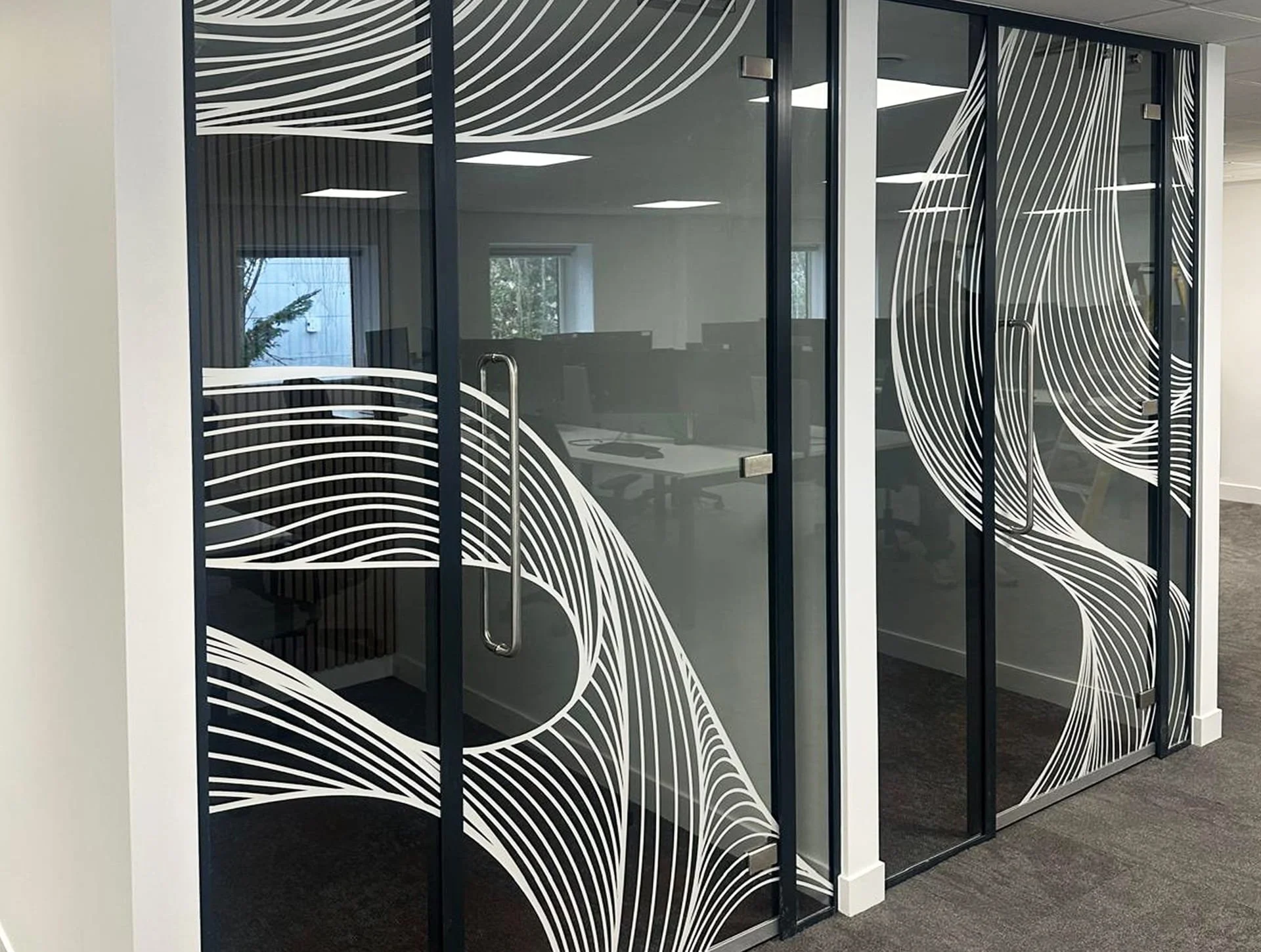
Office branding is the process of translating an organisation’s identity into the physical workplace through graphics, signage, materials, messaging and environmental design. For marketing managers, it sits at an unusual intersection between brand management, employee experience, interior design and facilities. A successful project therefore requires more than placing a logo behind reception or applying corporate colours to walls.
The workplace is one of the few brand environments experienced repeatedly by employees while also influencing clients, candidates, suppliers and visitors. Research from Gensler increasingly treats workplace experience as part of workplace performance, while Gallup identifies purpose, brand and culture as foundations of employee experience. The practical implication is straightforward: office branding should be approached as a spatial communication project, not simply a decorating exercise.
Key Takeaways
Office branding should be treated as a spatial communication project, with clear objectives for employees, visitors, clients and candidates established before design begins.
A detailed site survey is essential because sightlines, surfaces, lighting, access and building constraints directly influence what can be designed, manufactured and installed successfully.
Effective schemes create a hierarchy of brand moments rather than applying logos and graphics uniformly across every available surface.
Production and installation requirements should influence concepts from the beginning, reducing late-stage compromises, unexpected costs and conflicts between creative intent and technical feasibility.
Bringing brand, design, survey, production and installation expertise together creates greater continuity and gives marketing teams a clearer route from initial brief to completed workplace.
Start With the Purpose of the Workplace
Before discussing graphics, materials or finishes, define what the office needs to communicate and to whom. A headquarters receiving clients may require a different approach from an operational office primarily used by employees. A recruitment-focused technology business may want the environment to express culture and innovation, while a professional services firm may prioritise confidence, clarity and consistency.
Marketing managers should establish several objectives at the outset. These might include strengthening brand recognition, communicating company values, improving visitor experience, supporting recruitment, creating better wayfinding or making previously anonymous spaces feel connected to the organisation.
This prevents individual design decisions from becoming subjective. Instead of asking whether a wall graphic “looks good”, the team can ask whether it contributes to an agreed communication objective.
Audit the Space Before Designing It
Good environmental branding responds to the building rather than treating every available wall as advertising space. A physical survey should identify entrances, reception areas, circulation routes, meeting rooms, breakout areas, glazing, structural features, lighting conditions and important sightlines.
Grafiscape’s involvement at this stage can combine the brand discussion with practical survey information, photography, measurements and production considerations. This reduces the gap that can otherwise develop between a concept created on screen and something that can actually be manufactured and installed successfully.
Translate Brand Identity Into an Environment
A brand guideline document usually explains logos, typography, colours and graphic language. It rarely explains how those elements should behave across a twenty-metre corridor, reception wall, meeting suite or glazed partition.
Environmental branding therefore requires interpretation rather than simple reproduction. The strongest schemes establish a hierarchy. Some areas can carry prominent brand statements, while others should remain quieter. Repetition should be controlled so that logos retain impact rather than becoming visual wallpaper.
Consider how the organisation can be expressed beyond logos. Brand history, photography, product imagery, illustrations, values, achievements, local references or carefully selected messaging can create a richer environment. Material choice can also communicate character. Precision-cut lettering, architectural films, printed wallcoverings, dimensional graphics and fabricated signage each create different visual and tactile effects.
Design Around Journeys and Sightlines
People experience an office sequentially. The project should therefore consider what somebody sees when approaching the building, entering reception, waiting for a meeting, moving through corridors and arriving at key destinations.
Reception usually carries disproportionate importance because it establishes the first physical impression of the organisation. However, concentrating the entire budget there can leave the remainder of the workplace disconnected. A more considered scheme distributes brand moments according to visibility and purpose.
Wayfinding should form part of this thinking. Room identification, directional signage and floor or department markers can use the same visual language as decorative graphics. This creates consistency while ensuring that branding performs a practical function.
Gensler’s research has identified clarity, authenticity, inspiration and a sense of welcome among factors associated with positive experiences of designed spaces. For marketing managers, this reinforces the value of thinking about navigation and atmosphere alongside visual impact.
Bring Stakeholders Into the Process Early
Marketing may approve a concept that facilities later rejects. A landlord may prohibit a fixing method after artwork has been prepared. Furniture or electrical works may change after measurements are taken. An installer may discover that the specified substrate is unsuitable only when production is already underway.
Establishing responsibility early avoids unnecessary revisions. Marketing should normally retain responsibility for brand integrity and messaging, while technical specialists advise on materials, manufacture and installation. Facilities and property stakeholders should confirm access, permissions and building constraints.
Develop Concepts With Production in Mind
Environmental graphics should be designed at realistic scale and against accurate photographs, elevations or drawings. A graphic that appears restrained on an A3 presentation can become overwhelming across an eight-metre wall.
Production knowledge should influence concepts from the beginning. Printed vinyl, wallcovering, acrylic lettering, aluminium panels, window films and illuminated signage have different limitations, installation requirements, lifespans and cost implications. Selecting the method after the design is finalised can force compromises.
This is where using a company such as Grafiscape across design development, survey, production and installation can simplify decision-making. Rather than passing artwork between unrelated suppliers, technical questions can be resolved while the creative direction is still flexible. The benefit is less about convenience than maintaining continuity between brand intent and the finished environment.
Plan for Installation, Not Just Approval
Installation is often the least visible part of planning and one of the most consequential. Office access, working hours, security procedures, furniture movement, parking, loading, noise restrictions and other contractors can all affect delivery.
Marketing managers should also allow time for artwork approval and proofing. Names, dates, statistics, quotations and corporate claims should be checked carefully before manufacture. Once dimensional lettering has been fabricated or a wallcovering printed, correcting content becomes materially more expensive than changing a PDF.
Common Office Branding Mistakes
Office branding problems rarely begin with the quality of the finished print or signage. More often, they originate earlier in the project through inconsistent application of the brand, insufficient planning or decisions that do not account for how the workplace will actually be used.
Inconsistent Visual Identity
An office should feel like a physical extension of the same organisation people encounter through its website, marketing materials and communications. Incorrect colours, inconsistent typography, outdated logos or different interpretations of the brand across individual areas can make the workplace feel fragmented.
Consistency does not mean repeating identical graphics throughout the building. It means establishing a recognisable visual language and applying it appropriately across reception signage, wall graphics, meeting rooms, wayfinding and other branded elements.
Over-Branding Every Surface
More branding does not necessarily create a stronger brand environment. Applying logos, corporate colours and messaging to every wall, door and glazed partition can overwhelm the architecture and reduce the impact of the elements that should attract attention.
A more effective approach establishes hierarchy. Reception areas, feature walls and important communal spaces can carry stronger statements, while secondary spaces use quieter colours, materials, patterns or smaller details. Restraint gives important brand elements room to work.
Using Information That Will Quickly Become Outdated
Permanent graphics should be designed with their expected lifespan in mind. Campaign messages, statistics, employee numbers, dates, product ranges and other frequently changing information can make an otherwise well-designed installation appear outdated surprisingly quickly.
Where changing information is important, it may be better placed on replaceable panels, digital displays or graphic systems designed for straightforward updates. Permanent installations are generally better suited to established brand stories, values and content unlikely to change frequently.
Designing Without Understanding the Physical Space
A concept can work perfectly in a presentation and fail when transferred to a building. Viewing distance, natural and artificial lighting, furniture, doors, electrical fittings, glazing and architectural features all influence how graphics and signage are perceived.
Accurate surveying should therefore precede detailed production artwork. Measurements are only part of this process. Surface condition, substrate type, installation access and other physical restrictions can determine which materials and fixing methods are suitable.
Allowing the Environment to Contradict the Brand
Environmental branding cannot completely compensate for a workplace that communicates something different from the organisation's stated identity. A business presenting itself as precise and considered, for example, can undermine that message through poorly maintained graphics, confusing signage or an untidy reception experience.
Marketing managers should therefore consider the complete visitor and employee journey rather than graphics in isolation. Branding works most effectively when signage, interiors, lighting, furniture and spatial organisation reinforce rather than contradict one another.
Choosing Materials for Appearance Alone
Material selection should consider performance as well as appearance. Printed vinyl, architectural films, wallcoverings, fabricated lettering, acrylic, aluminium and illuminated signage each behave differently and have different requirements for installation and maintenance.
The appropriate specification depends on the substrate, location, expected lifespan, lighting, cleaning regime and level of physical contact. Selecting materials without considering these factors can result in premature deterioration or unnecessary replacement costs.
Neglecting Maintenance
Office branding continues to communicate after installation. Damaged lettering, lifting graphics, marked wallcoverings or outdated information can gradually undermine an otherwise professional environment.
Maintenance requirements should therefore form part of the original specification. Understanding how surfaces will be cleaned, which components can be replaced individually and how frequently high-contact areas should be inspected makes the branding easier to manage throughout its intended lifespan.
Ignoring Accessibility and Readability
A visually distinctive design is not successful if people struggle to understand it. Small typography, insufficient contrast, unnecessarily decorative fonts or poorly positioned directional information can make signage difficult to use.
Readability becomes particularly important for wayfinding, room identification and other functional information. These elements should be designed around viewing distance, positioning, contrast and the needs of different users rather than being treated purely as decorative extensions of the brand.
Involving Key Stakeholders Too Late
Marketing may approve a design before facilities teams, landlords, property managers or other stakeholders have reviewed how it will be installed. Restrictions concerning fixings, access, working hours, fire safety systems or protected surfaces can then emerge after substantial design work has already been completed.
Bringing the relevant stakeholders into the process earlier allows these constraints to become part of the brief. It also reduces the likelihood of late revisions, additional manufacturing costs or compromises immediately before installation.
Separating Design From Production Too Early
A final common mistake is treating creative design, technical specification, manufacture and installation as unrelated stages. Decisions made during concept development can have significant consequences for materials, tolerances, fixings and installation.
Connecting these disciplines from the outset allows technical feasibility to be considered without unnecessarily restricting the creative direction. It is one reason an integrated approach, where companies such as Grafiscape can survey, develop, produce and install the scheme, can be particularly useful for marketing teams managing a workplace branding project.
What This Means in Practice
For a marketing manager, an office branding project should follow the same discipline as any significant brand implementation: define objectives, understand audiences, gather accurate information, establish hierarchy, develop concepts, test feasibility, approve artwork and manage delivery.
Grafiscape can support that process from the initial site survey and creative interpretation through specification, artwork, manufacture and installation. That integrated approach is particularly useful where the marketing team wants creative ambition without becoming responsible for resolving substrates, fixings, access requirements and production tolerances.
The strongest brief is not “we need office graphics”. It explains what employees and visitors should understand or feel, which spaces matter most, what existing brand assets are available, what practical restrictions exist and what success should look like.
Creating an Office That Communicates Clearly
Effective office branding connects brand identity with the realities of a physical environment. It should help people understand where they are, whose organisation they are experiencing and what that organisation values, without turning every surface into a message.
For marketing managers, the key is to treat the workplace as a coherent brand touchpoint and to involve spatial, production and installation expertise early enough to influence the outcome. When strategy, design and delivery are considered together, office branding becomes more consistent, more practical and considerably easier to manage.
Frequently Asked Questions
-
Ideally, specialist involvement should begin before concepts are finalised. Early site assessment allows measurements, substrates, access restrictions, lighting and installation requirements to inform the creative process rather than forcing changes after designs have already been approved.
-
There is no requirement to brand every available surface. Stronger schemes establish a visual hierarchy, concentrating more prominent brand elements in important locations such as entrances, reception areas and key communal spaces while allowing quieter areas to support the overall environment more subtly.
-
A useful brief should explain the project objectives, audiences, priority spaces, available brand assets, desired messages, practical restrictions and intended outcome. Existing brand guidelines, architectural drawings, floor plans and information about other planned works can also help the design and survey process.
-
Costs are influenced by the size and number of areas being treated, chosen materials, fabrication methods, installation complexity, access requirements and the condition of existing surfaces. Establishing priorities early allows the available budget to be focused on the spaces where branding will have the greatest purpose and visibility.
-
Timelines vary according to the scale of the workplace, complexity of the design, approval process, manufacturing requirements and installation conditions. Projects involving fabricated signage, specialist materials, multiple stakeholders or restricted installation hours generally require more planning than straightforward graphic applications.
-
Yes. Grafiscape can support the process through site survey, creative interpretation, specification, artwork, manufacture and installation. Keeping these stages connected allows technical considerations to be addressed during design development and helps preserve the intended brand experience through to the finished environment.
